Mama Mis Her We Go Again
Westward atching the original Mamma Mia! in 2008, I had something approaching an out-of-torso experience. Having initially scoffed at everything from the contrived join-the-pop songs plot to Pierce Brosnan's unique vocal stylings, I felt my feathery inner cocky depart from my dour outside and start dancing in the aisles. Ane infinitesimal I was a miserable critic; the next, everything had gone pinkish and fluffy. As I said at the time, never earlier had something so wrong felt so correct.
A decade afterward, this sequel-prequel hybrid (a surprisingly smart combination) produces similarly head-spinning results. In the 1979 sequences, Lily James plays the young Donna, graduating from Oxford (via a High Schoolhouse Musical-mode rendition of When I Kissed the Teacher) before heading off on an endless holiday wherein she will try on a pair of dungarees and a trio of handsome suitors. Meanwhile, in the nowadays, Amanda Seyfried'southward Sophie is striving to fulfil her mother's vision (she had a dream!) with the newly renovated Hotel Bella Donna, while wrestling with the prospect of history repeating itself on this idyllic island.
As we flip-flop through the singalong hi-jinks, Hugh Skinner, Josh Dylan and Jeremy Irvine grow up to get Colin Firth, Stellan Skarsgård and Pierce Brosnan, while Jessica Keenan Wynn and Alexa Davies prove dab hands at essaying younger incarnations of dynamic duo Christine Baranski and Julie Walters.
Taking over the directorial reins, Ol Parker (who made Imagine Me & Yous and the underrated Now Is Good) delivers a slicker bundle than Phyllida Lloyd'due south record-breaking original, full of elegant photographic camera moves, snappy choreography and mirrored shots juxtaposing disparate frames, both temporal and spatial. Alongside Parker, the credited writers include Richard Curtis, who may or may non be responsible for such post-4 Weddings zingers as "Be still my chirapsia vagina" and "It's called karma and it's pronounced 'Ha!"'
Still as earlier, the real pleasure comes from the sublime agony of hearing your favourite Abba tunes crowbarred into the narrative in increasingly preposterous ways. Occasionally the twists are subtle (the whoopingly affirmative "woh woh woh" of Waterloo briefly becomes a commanding "whoa" – as in "stop!" – during a restaurant seduction scene). More often they're laugh-out-loud ludicrous (the scene in which Cher calls Andy Garcia'due south Señor Cienfuegos by his starting time name evokes Ben Elton's script for We Will Stone You). Crucially, such creaks announced to be entirely knowing, encouraging us to laugh with the story, rather than at information technology – something I'm not entirely sure was true of the original stage musical and film.
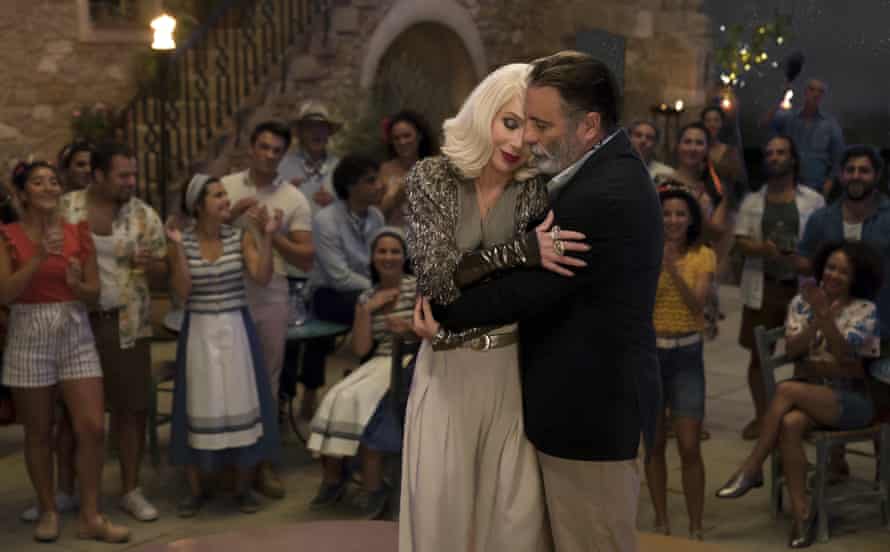
Information technology helps that the ensemble bandage are extremely likable and admirably game; the lyrics to Dancing Queen may insist that "you can trip the light fantastic toe, you lot can jive", just the fact that many of the men can practise neither of the above doesn't end them from having the time of their lives anyway. Past contrast, the women are on pinnacle grade – from Lily James, who could charm the birds from the trees with her vocal-and-trip the light fantastic toe skills, to Julie Walters, whose brand of note-perfect concrete comedy (it'south all in the expressions and gestures) proves a reliable delight. Meanwhile, Omid Djalili is a scene-stealing hoot as a withering community and passport control officer (NB: stay to the very end of the credits).
None of this would mean a thing if Mamma Mia! Here Nosotros Go Again didn't also pack an emotional punch, and I experience duty-jump to report that I came out of the screening an utter wreck. The tears started early, as James and co danced around a cameoing Björn Ulvaeus, then flowed freely as the hits continued, climaxing in a Dunkirk-style flotilla routine complete with a cheeky nod to Titanic, the picture show that the original Mamma Mia! famously outperformed at the UK box office.
Yet having ever believed that Abba'southward greatest song was a melancholy gem from the Arrival LP, it was the spine-tingling reworking of My Dearest, My Life that hit me hardest. I wasn't simply crying – I was convulsing with tears, desperately trying to stop myself from audibly sobbing. Seriously, the end of Apocalypse Now proved less traumatic.
Much has changed in the 10 years since Mamma Mia! challenged my ideas of "good" and "bad" film-making. I take certainly mellowed, and possibly my critical faculties have withered and died. But I just tin't imagine how Mamma Mia! Here We Become Again could be any improve than it is. I loved information technology to pieces and I tin can't look to go once more!
Source: https://www.theguardian.com/film/2018/jul/22/mamma-mia-here-we-go-again-review
0 Response to "Mama Mis Her We Go Again"
Post a Comment